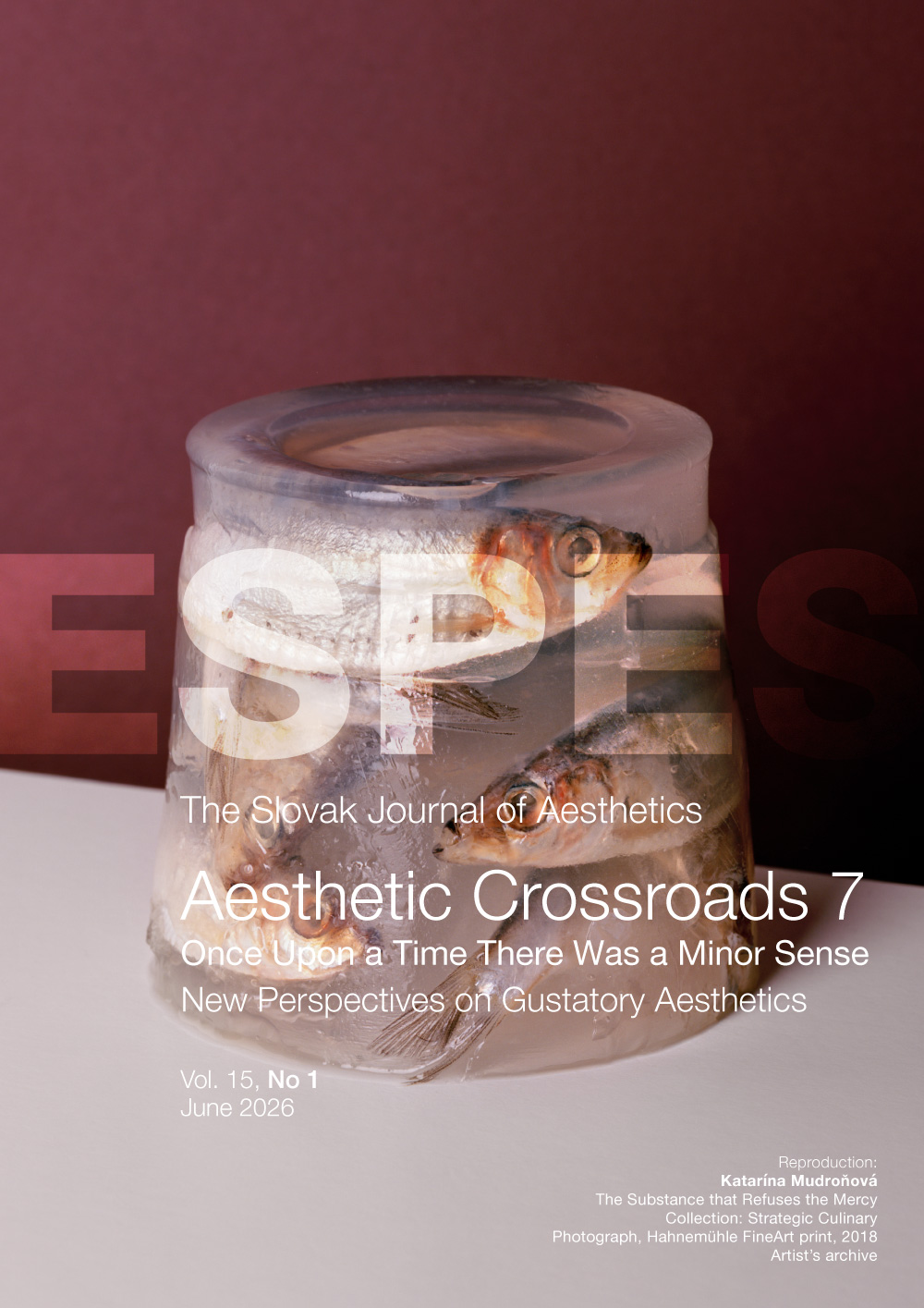
The Secret of Taste
Derrida on Non-Appropriation
DOI:
https://doi.org/10.5281/zenodo.21787923Keywords:
Taste, Disgust, Auto-Affection, Ex-Appropriation, Jacques DerridaAbstract
This article investigates taste in the corpus of Jacques Derrida, focusing on its emergence across published works and unpublished seminars. Starting from A Taste for the Secret and Economimesis, and through a close reading of Manger l’autre (1989–1990) and Rhétorique du cannibalisme (1990–1991), it follows the ways in which taste appears as an experience of auto-affection that maintains a structural relation to what exceeds and resists consumption. Rather than presenting taste as a pure alternative to appropriation, the article interprets it as a limit-experience in which contact, incorporation, and knowledge encounter what cannot be fully assimilated. It thus proposes to understand taste as a nonappropriative posture, capable of orienting the relation between aesthetics and ethics without resolving it into a normative synthesis. Approaching the seminars as a theoretical laboratory, the contribution shows how taste operates in Derrida’s thought as a critical instance with respect to any economy of appropriation.
References
Campos-Salvaterra, V. (2021) ‘De cenas y tumbas. Algunas configuraciones retóricoespeculativas del Derrida de los 70’, Revista de Filosofía Aurora, 33(60), pp. 1027–1052.
Derrida, J. (1975) Économimesis. Paris: Flammarion.
Derrida, J. (1989–1990) Politiques de l’amitié: Manger l’autre. Unpublished seminar. Fonds Jacques Derrida, IMEC.
Derrida, J. (1990–1991) Politiques de l’amitié: Rhétorique du cannibalisme. Unpublished seminar. Fonds Jacques Derrida, IMEC.
Derrida, J. (2001 [1996]) A Taste for the Secret. Translated by G. Donis. Cambridge: Polity Press.
Derrida, J. (2002) ‘Reste – le maître ou le supplément d’infini’, in Bansat-Boudon, L. and Scheid, J. (eds) Le Genre Humain: Le disciple et ses maîtres: Pour Charles Malamoud. Paris: Seuil, pp. 25–63.
Guyer, S. (2007) ‘Buccality’, in Schwab, G. (ed.) Derrida, Deleuze, Psychoanalysis. New York: Columbia University Press.
Heidegger, M. (1954) Was heißt Denken? Frankfurt am Main: Vittorio Klostermann.
Heidegger, M. (1962) Die Frage nach dem Ding: Zu Kants Lehre von den transzendentalen Grundsätzen. Tübingen: Max Niemeyer.
Kolnai, A. (2004 [1929]) ‘On Disgust’, in Korsmeyer, C. and Smith, B. (eds) On Disgust. Chicago-La Salle: Open Court.
Krell, D.F. (2006) ‘All You Can’t Eat: Derrida’s Course “Rhétorique du cannibalisme” (1990–1991)’, Research in Phenomenology, 36(1), pp. 130–180.
Menninghaus, W. (2003) Disgust: The Theory and History of a Strong Sensation. New York: State University of New York Press.
Perullo, N. (2011) ‘Mangerida. Per una “gastronomia a venire”’, in La scena del senso: a partire da Wittgenstein e Derrida. Pisa: Edizioni ETS.