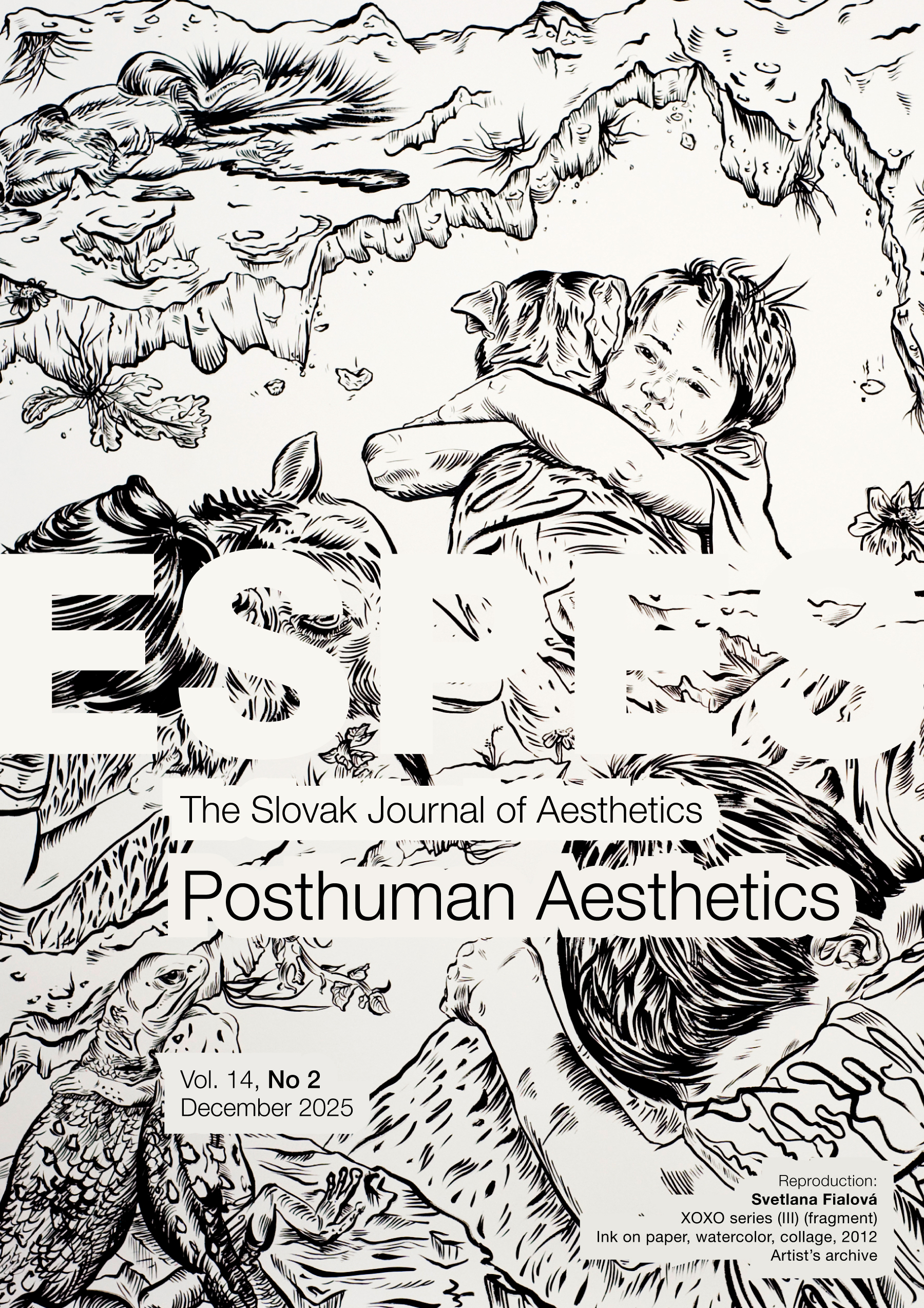
Aesthetics of Posthumanism
Reimagining Human Cohabitations
DOI:
https://doi.org/10.5281/zenodo.18639989Keywords:
Posthumanism, Anthropocentrism, Anthropocene, Deconstruction, Phenomenology, Schizoanalysis, Imagination, Critical Thinking, Cognitive Emotions, CohabitationAbstract
This article introduces the aesthetics of posthumanism as a genuine trend in philosophical aesthetics that emerged in the early decades of the 21st century. Engaging with an innovative imagination of the cohabitation of various life forms, the aesthetics of posthumanism rethinks interspecies encounters across both cultural and natural environments, prompting us to consider ethically motivated images of environmental awareness and creative adaptation. Building on phenomenological, deconstructive, and schizoanalytic methodological insights, this article aims to highlight a turning point in contemporary aesthetic research that questions our anthropocentric, speciesist prejudices and presents them as obsolete in a world shaped by the global environmental crisis. To address the complexity of this topic, the article presents contributions that map various approaches to the ‘posthuman situation’ in the artistic and philosophical imagination of contemporary human identity. The first set of referred texts targets the multifaceted – environmental, social, and technological – disaster caused by the speciest, self-centred humanism of the modern era, and the subsequent rupture of posthumanist art from it. This aesthetic perspective gives rise to resistance through posthumanist engagement. The second set of references addresses various problems related to anthropocentrist aesthetics. By introducing thinkers who articulate distinct viewpoints on the politics of aesthetic imagination, this article presents two contrasting approaches to contemporary visuality: while one group welcomes the environmentally caring approach of post-anthropocentrism, the other advocates preserving the anthropocentric one.
References
Aaltola, E. (2018) Varieties of Empathy: Moral Psychology and Animal Ethics. Lanham: Rowman and Littlefield.
Aaltola, E. (2012) Animal Suffering: Philosophy and Culture. Basingstoke: Palgrave Macmillan.
Barad, K. (2003) ‘Posthumanist Performativity: Toward an Understanding of How Matter Comes to Matter’, Signs, 28(3), pp. 801–831.
Dürbeck, G., Hüpkes, Ph. (2020) The Anthropocenic Turn. London: Routledge.
Bauman, Z. (2002) Modernity and the Holocaust. Cornell University Press.
Bentham, J. (1970) An Introduction to the Principles of Morals and Legislation. London: Athlone Press.
Buchanan, B. (2008) Onto-Ethologies: The Animal Environments of Uexküll, Heidegger, Merleau-Ponty, and Deleuze. Albany: SUNY Press.
Calarco, M. (2008) Zoographies: The Question of the Animal from Heidegger to Derrida. New York: Columbia University Press.
Calarco, M. (2015) Thinking Through Animals: Identity, Difference, Indistinction. Stanford University Press.
Cavalieri, P. (2008) The Death of the Animal: A Dialogue. New York: Columbia University Press.
Cavalieri, P. (2001) The Animal Question: Why Nonhuman Animals Deserve Human Rights. Oxford: Oxford University Press.
Cimatti, F. (2020) Unbecoming Human. Philosophy of Animality After Deleuze. Translated by F. Gironi. Edinburgh: Edinburgh University Press.
Darwin, Ch. (1995) On the Origin of Species. Gramercy.
Deleuze, G. and Guattari, F. (1987) A Thousand Plateaus. Minneapolis: University of Minnesota Press.
Derrida, J. (2008) The Animal that Therefore I Am. Translated by D. Wills. New York: Fordham.
Dufourcq, A. (2022) The Imaginary of Animals. London: Routledge.
Fredriksson, A. (2011) ‘Environmental Aesthetics beyond the Dialectics of Interest and Disinterest: Deconstructing the Myth of Pristine Nature’, Nordic Journal of Aesthetics, 40–41, pp. 89–105.
Fritsch, M., Lynes, Ph. and Wood, D. (2018) Eco-Deconstruction: Derrida and Environmental Philosophy. Fordham University Press.
Galton, F. (1904) Eugenics: Its Definition, Scope, and Aims. Cosimo Classics.
Gosetti-Ferencei, J. (2017) ‘The Imagination of Animals. Rilke, Kafka – Literature and the Philosophy of Embodied Cognition’, In: Dierckxsens, G., Bijlsma, R., Begun, M. and Kiefer, T. (eds.) The Animal Inside. Essays on the Intersection of Philosophical Anthropology and Animal Studies. Lanham: Rowman and Littlefield, pp. 123–146.
Haraway, D. (2003) The Companion Species Manifesto. Chicago: Prickly Paradigm Press.
Haraway, D. (2008) When Species Meet. Minneapolis: University of Minnesota Press.
Jerolmack, C. (2008) ‘How Pigeons Became Rats: The Cultural-Spatial Logic of Problem Animals’, Social Problems, 55(1), pp. 72–94.
Jonas, H. (1984) The Imperative of Responsibility: In Search of an Ethics for the Technological Age. Chicago: University of Chicago Press.
Kant, I. (2009) Critique of Judgement. Oxford University Press.
Lyotard, J.-F. (1991) The Inhuman. Reflections of Time. Polity Press.
Lyotard, J.-F. (1994) Lessons on the Analytic of the Sublime. Stanford University Press.
Lyotard, J.-F. (1984) The Postmodern Condition. Manchester University Press.
Mandieta, E. (2024) The Philosophical Animal. On Zoopoetics and Interspecies Cosmopolitanism. State University of New York Press.
Massumi, B. (2014) What Can the Animals Teach us about Politics? Durham: Duke University Press.
Merleau-Ponty, M. (1963) The Structure of Behaviour. Beacon Press.
Merleau-Ponty, M. (2003) Nature: Course Note from the College de France. Translated by R. Vallier. Evanston: Northwestern University Press.
Montaigne, M. de (1943) ‘Of Cruelty’, In: The Complete Works of Michel de Montaigne. Translated by D.M. Frame. London: Everyman. pp. 379–385.
Nagel, T. (1974) ‘What is it like to be a bat?’, The Philosophical Review, 83(4), pp. 435–450.
Nancy, J.-L. (2000) Being Singular Plural. Translated by R. Richardson and A. O’Byrne. Stanford: Stanford University Press.
Nussbaum, M. (1996) ‘Compassion: The Basic Social Emotion’, Social Philosophy and Policy, 13(1), pp. 27–58.
Nussbaum, M. (2001) Upheavals of Thought: The Intelligence of Emotions. Cambridge: Cambridge University Press.
Nussbaum, M. (2004) ‘Beyond Compassion and Humanity: Justice for Nonhuman Animals’, In: C.R. Sunstein and M. Nussbaum (eds.) Animal Rights. Current Debates and New Directions. Oxford: Oxford University Press, pp. 299–320.
Nussbaum, M. (2006) Frontiers of Justice: Disability, Nationality, Species Membership. Cambridge: The Belknap Press of Harvard University Press.
Nussbaum, M. (2023) Justice for Animals: Our Collective Responsibility. New York: Simon & Schuster.
Pokorný, V. (2024) ‘Post-trans-meta: k pojmové analýze posthumanismu’, Filosofický časopis, 2, pp. 30–56.
Rousseau, J.-J. (2009) Emile, or on Education. Translated by A. Bloom. New York: Basic Books.
Rousseau, J.-J. (1979) Discourse on the Origins of Inequality. Translated by F. Philip. Oxford: Oxford University Press.
Schopenhauer, A. (1995) On the Basis of Morality. Translated by E.F.J. Payne. Cambridge: Hackett.
Steiner, G. (2005) Anthropocentrism and its Discontents. University of Pittsburgh Press.
Still, J. (2015) Derrida and Other Animals: The Boundaries of the Human. Edinburgh: Edinburgh University Press.
Voltaire, F.-M. A. (1918) Candide. CreateSpace.
Weininger, O. (2005) Sex and Character. Indiana University Press.
Wyckoff, J. (2015) ‘The Problem of Speaking for Animals’, In: Aaltola, E. and Hadley, J. (eds.) Animal Ethics and Philosophy: Questioning the Orthodoxy. Rowman and Littlefield, 2015, pp. 117–132.
Wolfe, C. (2010) What Is Posthumanism? Minneapolis: University of Minnesota Press.
Wolfe, C. (2026) Jagged Ontologies. Posthumanities. Minneapolis: University of Minnesota Press.