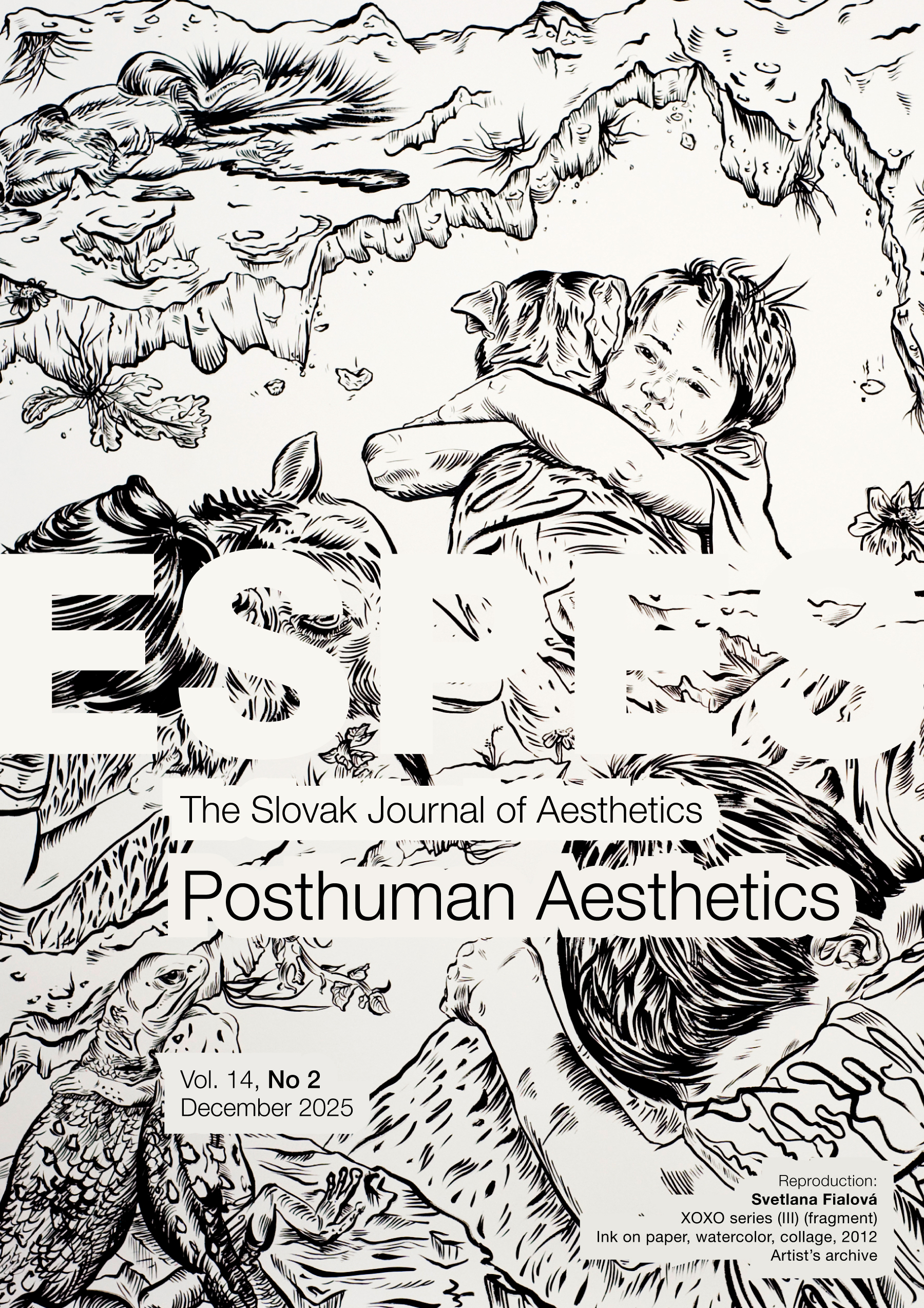
Posthuman Animality
Situating Theories of Companion Species and Becoming-with in Netflix’s Love, Death and Robots, Volume-IV
DOI:
https://doi.org/10.5281/zenodo.18640516Keywords:
Posthuman Aesthetics, Animality, Companion Species, Solidarity, Community, Ethical SensibilityAbstract
This article analyses the fourth volume of Love, Death and Robots (2025) to explore how animality can be explored through posthuman aesthetics. Animals have always been historical beings, and their histories are inextricably tied to human activities. By not privileging humans over non-human animals, we can aim for a networked environment with companion species devoid of any binaries. By engaging with Donna Haraway’s theories of companion species, Deleuze and Guattari’s theories of becoming animals, Mitchell and Krause’s concepts of animal consciousness and Skonieczny’s concept of the animal turn, this paper focuses on the connections between different aesthetics, ethics, and politics of different animals. This article thus demonstrates that posthuman aesthetics represented through the animals in Love, Death and Robots challenges traditional humanist aesthetics and evokes an alliance of different realms and ecologies.
References
Braidotti, R. (2009) ‘Animals, Anomalies, and Inorganic Others’, MLA, 124(2), pp. 526–532. Available at: https://www.jstor.org/stable/25614294 (Accessed: 28 October 2025).
Buchanan, B. (2008) Onto-Ethologies: The Animal Environments of Uexküll, Heidegger, Merleau-Ponty, and Deleuze. Albany, NY: State University of New York Press.
Cascales, R. (2025) ‘Breaking Aesthetic Boundaries: Arthur Danto, Yuriko Saito, and the Challenge to Western Aesthetic Thought’, ESPES The Slovak Journal of Aesthetics, 14(1), pp. 201–217. Available at: https://doi.org/10.5281/zenodo.15870455 (Accessed: 8 January 2026).
Cavalieri, P. (2001) The Animal Question: Why Nonhuman Animals Deserve Human Rights. Oxford: Oxford University Press.
Cimatti, F. (2016) ‘Posthumanism and Animality’, Lo Sguardo–rivista di filosofia (24), pp. 111–123.
Dean, E. (2025) ‘For He Can Creep’, Love, Death and Robots. Blur Studio: Netflix.
Deleuze, G. and Guattari, F. (1987) A Thousand Plateaus: Capitalism and Schizophrenia. Translated by B. Massumi. Minneapolis: University of Minnesota Press.
Descartes, R. (2006) A discourse on the method of correctly conducting one’s reason and seeking truth in the sciences. Oxford New York: Oxford University Press (Oxford world’s classics).
Dufourcq, A. (2022) The Imaginary of Animals. London and New York: Routledge.
Feldherr, A. (2006) ‘Metamorphosis in the Metamorphoses’, in Hardie, P. (ed.) The Cambridge Companion to Ovid. Cambridge: Cambridge University Press, pp. 163–179.
Ferrando, F. (2016) ‘A feminist genealogy of posthuman aesthetics in the visual arts’, Palgrave Communications, 2(16011), pp. 1–12. doi: 10.1057/palcomms.2016.11
Gymnich, M. and Costa, A. S. (2006) ‘Of Humans, Pigs, Fish, and Apes: The Literary Motif of Human-Animal Metamorphosis and its Multiple Functions in Contemporary Fiction’, L’Esprit Créateur, 46(2), pp. 68–88. Available at: https://www.jstor.org/stable/26289224 (Accessed: 28 October 2025).
Haraway, D. (1985) A Cyborg Manifesto: Science, Technology, and Socialist-Feminism in the Late Twentieth Century. Minneapolis: University of Minnesota Press.
Haraway, D. (2003) The Companion Species Manifesto: Dogs, People, and Significant Otherness. Chicago: Prickly Paradigm Press.
Haraway, D. (2008) When Species Meet. Minneapolis: University of Minnesota Press.
Lorimer, J. (2012) ‘Aesthetics for post-human worlds: Difference, expertise and ethics’, Dialogues in Human Geography, 2(3), pp. 284–87. doi: 10.1177/2043820612468646
Massumi, B. (2014) What Animals Teach Us about Politics. Durham and London: Duke University Press.
Mendieta, E. (2024) The Philosophical Animal: On Zoopoetics and Interspecies Cosmopolitanism. Albany, NY: State University of New York Press.
Miller, T. (2025) ‘Golgotha’, Love, Death and Robots. Blur Studio: Netflix.
Miller, T. (2025) ‘The Screaming of the Tyrannosaur’, Love, Death and Robots. Blur Studio: Netflix.
Mitchell, R.W. and Krause, M. A. (2024) ‘Animal Consciousness and Cognition’, in Aftandilian, D., Ambros, B. R. and Gross, A. S. (eds.) Animals and Religion. London and New York: Routledge, pp. 37–47.
Nelson, J. Y. (2025) ‘Spider Rose’, Love, Death and Robots. Blur Studio: Netflix.
Osborne, P. (2025) ‘The Other Large Thing’, Love, Death and Robots. Blur Studio: Netflix.
Singer, P. (2006) In Defense of Animals: The Second Wave. United Kingdom: Blackwell Publishing Ltd.
Skonieczny, K. (2022) ‘The Animal Turn as a Challenge to Humanism’, in Bryson, M. (ed.) The Routledge Companion to Humanism and Literature. New York and London: Routledge, pp. 86–98.
Wamberg, J. and Thomsen, M. R. (2016) ‘The Posthuman in the Anthropocene: A Look through the Aesthetic Field’, European Review, 25(1), pp. 150–165. doi: 10.1017/S1062798716000405
Wood, D. (2020) Thinking Plant Animal Human: Encounters with Communities of Difference. Minneapolis: University of Minnesota Press.