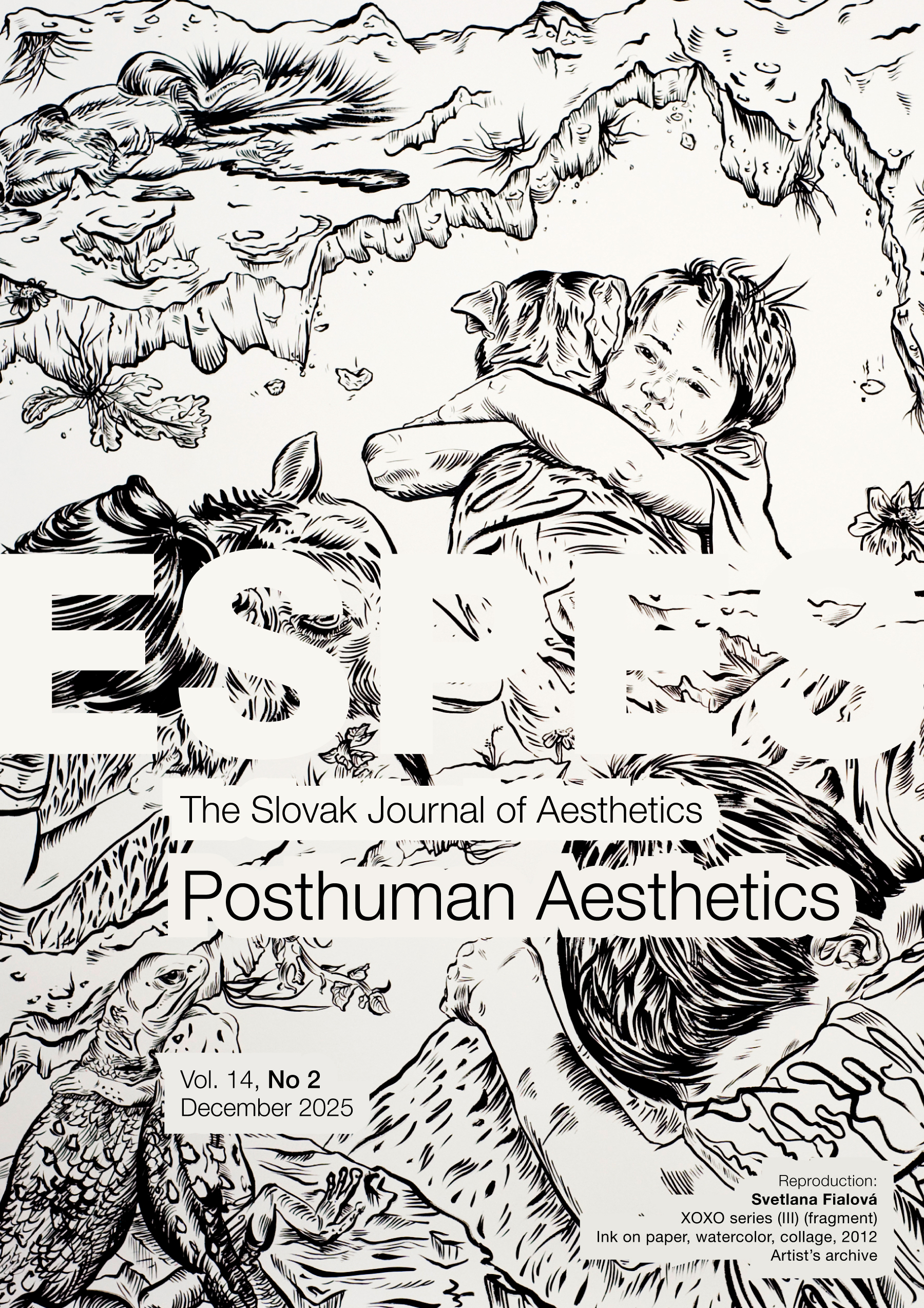
Opening Aesthetics
Posthumanism and the Crisis of Form in the Anthropocene
DOI:
https://doi.org/10.5281/zenodo.18640911Keywords:
Aesthetics, Anthropocene, Formless, Open Aesthetics, PosthumanismAbstract
The ongoing collapse of the Earth System’s functionality is fundamentally reshaping our thinking about nature and the conditions of existence on Earth. As an era of ontological destabilisation, the Anthropocene can be described as a dark ecology that radically deforms our sensibilities, guiding multidisciplinary attempts to grasp a new naturecultural regime. Anthropocene aesthetics is an encounter with the more-than-human forces of the Earth System that goes beyond traditional art forms and aesthetic strategies. In our essay, we explore contemporary aesthetic approaches to the Anthropocene, highlighting the posthuman aspect of Anthropocene aesthetics. In our view, the defining aesthetic trends of the Anthropocene are determined by the post-anthropocentric or posthuman turn. Posthuman art is not about nonhumans creating art without us. Rather, it foregrounds the naturecultural forces that define and shape life on our planet.
References
Ahuja, N. (2017) ‘Posthuman New York: Ground Zero of the Anthropocene’, In: Lundblad, M. (Ed.) Animalities: Literary and Cultural Studies Beyond the Human. Oxford: Oxford University Press, pp. 43–59.
Ballard, S. (2021) Art and nature in the Anthropocene: Planetary aesthetics. London and New York: Routledge.
Bonneuil, C. and Fressoz, J. B. (2016) The Shock of The Anthropocene. The Earth, History and Us. London and New York: Verso.
Boysen, B. (2025) The Embarrassment of Being Human: A Critical Essay on the New Materialisms and Modernity in an Age of Crisis. London and New York: Routledge.
Colebrook, C. (2015) Death of the PostHuman. Essays on Extinction Vol. 1. Ann Arbor: Open Humanities Press.
Dang, T. (2025) New Weird Fiction and the Anthropocene. Jeff VanderMeer and Ecological Awareness. New York and London: Palgrave Macmillan.
Dion, M. (2017) Project for a Monument to the Anthropocene. Available at: http://www.anthropocenemonument.com/mark-dion/ (Accessed: 30 October 2025).
Dudek, M. (2025) ‘Understanding dormant object: contributing to a fuller account of the entities implied in Graham Harman’s object-oriented ontology’, Foundations of Science, 30, pp. 1021–1040.
Dürbeck, G. and Hüpkes, P. (2021) ‘The Anthropocene as an age of scalar complexity: Introduction’, In: Dürbeck, G. and Hüpkes, P. (eds.) Narratives of Scale in the Anthropocene. Imagining Human Responsibility in an Age of Scalar Complexity. New York and London: Routledge, pp. 1–20.
Fressoz, J. B. (2021) ‘The Anthropocenic Sublime: A Critique’, In: Boyden, M. (ed.) Climate and American Literature. Cambridge Themes in American Literature and Culture. Cambridge: Cambridge University Press, pp. 288–299.
Haila, Y. (2000) ‘Beyond the nature-culture dualism’, Biology and Philosophy, 15(2), pp. 155–175.
Hamilton, C. (2017) Defiant Earth. The Fate of Humans in the Anthropocene. Malden: Polity Press.
Harman, G. (2019) Art and Objects. Malden: Polity.
Harman, G. (2005) Guerrilla Metaphysics. Phenomenology and the Carpentry of Things. Chicago and La Salle: Open Court.
Henriksen, D.; Creely, R. and Mehta, R. (2022) ‘Rethinking the politics of creativity: Posthumanism, indigeneity, and creativity beyond the western Anthropocene’, Qualitative Inquiry, 28(5), pp. 465–475.
Holloway, T. (2022) How to Live at the End of the World: Theory, Art, and Politics for the Anthropocene. Stanford: Stanford University Press.
Horn, E. (2020) ‘Challenges for an Aesthetics of the Anthropocene’, In: Dürbeck, G. and Hüpkes, P. (eds.) The Anthropocenic Turn. The Interplay between Disciplinary and Interdisciplinary Responses to a New Age. New York and London: Routledge, pp. 159–172.
Horn, E. (2018) ‘The Anthropocene sublime: Justin Guariglia’s artwork’, In: J. Reiss (ed.) Art, Theory and Practice in the Anthropocene. Wilmington: Vernon Press, 1-8.
Horn, E. and Bergthaller, H. (2019) The Anthropocene: Key issues for the humanities. New York and London: Routledge.
Ivanov, A.A. (2025) ‘Graham Harman’s Weird Realism and Its Influence on Contemporary Art and Architecture’, Culture and Art, 10, pp. 211–225.
Jonsson, K.A. (2025) ‘Drowned Futures and Ecological Reflections: Mediations of a Disanthropic Earth’, Manifest Destiny and The Aquatic Adventure of the Last Human, Ekphrasis. Images, Cinema, Theory, Media, 33(1), pp. 268–289.
Lombard, D.; Sperling, A. and Vermeulen, P. (2025) ‘Anthropocene Sublimes. An Introduction’, Ecozona, 16(1), pp. 1–14.
Luhmann, N. (2000) The Reality of the Mass Media. Translated by K. Cross. Stanford University Press.
Lyotard, J. F. (1994) Lessons on the Analytic of the Sublime. (Kant’s 'Critique of Judgment,’ §§23-29). Translated by E. Rottenberg. Stanford: Stanford University Press.
Lyotard, J. F. (1985) ‘The sublime and the avant garde’, Paragraph, 6(1), pp. 1–18.
Morton, T. (2021) All Art Is Ecological. London and New York: Penguin Books.
Morton, T. (2016) Dark ecology: For a logic of future coexistence. New York: Columbia University Press.
Morton, T. (2013) Hyperobjects. Philosophy and Ecology After the End of the World. Minneapolis and London: University of Minnesota Press.
Morton, T. (2009) Ecology Without Nature. Rethinking environmental aesthetics. Harvard: Harvard University Press.
Pugh, J., and Chandler, D. (2021) Anthropocene islands: Entangled worlds. London: University of Westminster Press.
Richardson, M. ‘Witnessing the Anthropocene: affect and the problem of scale’, Parallax, 26(3), pp. 339–359.
Saunders, R. A. (2024) ‘A See change? The problematic (visual) politics of screening the Anthropocene’, Critical Studies in Television, 19(3), pp. 292–313.
Skiveren, T. (2023) ‘New materialism and the eco-Marxist challenge: Ontological shadowboxing in the environmental humanities’, Environmental Humanities, 15(2), pp. 181–194.
Spivak, G. C. (2023) Death of a Discipline. New York: Columbia University Press.
Staver, A. (2025) Ohio bill would ban AI from marrying humans, owning property. Available at: https://www.msn.com/en-us/news/us/ohio-bill-would-ban-ai-frommarrying-humans-owning-property/ar-AA1PqUsn (Accessed: 30 October 2025).
Stępień, J. (2022) Posthuman and Nonhuman Entanglements in Contemporary Art and the Body. New York and London: Routledge.
Strathausen, C. (2022) ‘Aesthetics, Autopoiesis, and Posthumanism’, In: Herbrechter, S.; Callus, I.; Rossini, M.; Grech, M. and De Bruin-Molé, M. (eds.) Palgrave Handbook of Critical Posthumanism. New York and London: Palgrave Macmillan, pp. 337–361.
Turnbull, J., Platt, B., and Searle, A. (2022) ‘For a new weird geography’, Progress in Human Geography, 46(5), pp. 1207–1231.
Winton, D. (2017) Mark Dion: New England Digs. Available at: https://bellgallery.wordpress.com/2017/11/01/mark-dion-new-england-digs/ (Accessed: 30 October 2025).
Wolfe, C. (2021) Art and Posthumanism. Essays, Encounters, Conversations. Minneapolis and London: University of Minnesota Press.
Woods, D. (2014) ‘Scale critique for the Anthropocene’, The Minnesota Review, 83, pp. 133–142.
Young, N. (2021) ‘Object, reduction, and emergence: An object-oriented view’, Open Philosophy, 4(1), pp. 83–93.